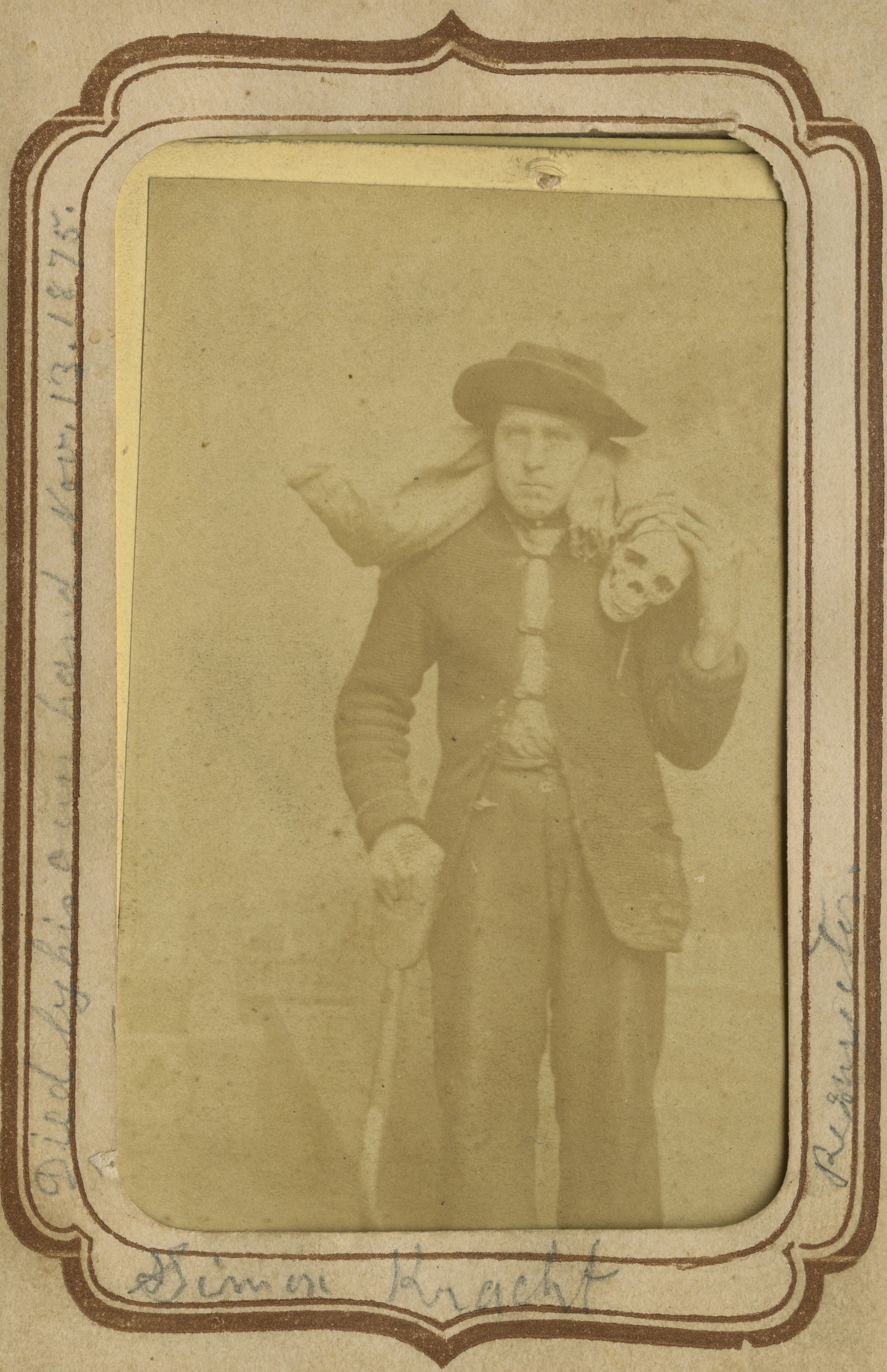
The Man Who Stole the Dead to Teach the Living
The True and Unsettling Story of Simon Kracht, Louisville’s Forgotten Resurrectionist
Louisville, Kentucky — December 1872
A wagon arrived at the University of Louisville’s medical school carrying something that should have been resting six feet beneath the ground.
Four dead bodies.
They weren’t donations to science. They weren’t necessarily people who had expressed any desire to help educate future physicians.
They were corpses obtained through a shadowy business that respectable medical institutions needed but few wanted to acknowledge publicly.
And one of the men unloading them wasn’t a physician, a surgeon, or even a medical student.
He was the janitor.
His name was Simon Kracht.
Within moments, Kracht and the medical student accompanying him would find themselves under arrest.
But the most remarkable part of the story isn’t that a university employee was caught handling stolen bodies.
It’s that grave robbing was part of his job.
And the university he served would eventually become one of Kentucky’s most important institutions of medical education.
How did a man who stole from the dead become part of that history?
To understand, we have to return to a time when learning how to save lives sometimes began with breaking into graves.
A Medical School With a Terrible Problem
In 1837, the Louisville Medical Institute opened with 80 students and seven faculty members.
The school stood at Eighth and Chestnut streets in Louisville, a growing river city determined to establish itself as a center of medicine and learning.
By 1846, the institute had become the Medical Department of the University of Louisville.
Medical education was expanding. Students traveled from across the South and West to study under respected professors, attend lectures, observe operations, and learn the complicated workings of the human body.
But there was a problem that textbooks couldn’t solve.
You cannot properly teach human anatomy without studying actual human anatomy.
Students needed to see muscles, nerves, arteries, organs, and bones. They needed to understand how the pieces fit together, what happened when something went wrong, and what a surgeon might encounter while operating.
A mistake made inside a living patient could be fatal.
Dissecting a human cadaver provided knowledge that drawings and lectures alone could never fully reproduce.
Unfortunately, obtaining those bodies legally was extraordinarily difficult.
At the time, executed criminals were one recognized source of cadavers. But executions could never provide enough bodies for the rapidly growing medical profession.
As a result, medical schools found themselves facing an uncomfortable choice.
Limit the practical education of future doctors.
Or find another way to obtain the dead.
Some chose another way.
And that decision gave rise to one of the most disturbing occupations in American history.
The Men Who Worked After Dark
They were called resurrectionists.
The name sounded almost religious, as though these men possessed the miraculous ability to raise people from the grave.
They didn’t.
They simply dug people back up.
Professional body snatchers became part of an underground economy supplying medical schools with corpses.
The business demanded secrecy, physical labor, and a willingness to violate one of society’s most deeply held customs: the right of the dead to rest undisturbed.
Historical descriptions of the trade reveal a chilling process.
A resurrectionist might locate a newly filled grave, remove only enough dirt to expose part of the coffin, break through the lid, and extract the body with a rope.
The disturbed earth could then be replaced, leaving families unaware that their loved one’s resting place had been violated.
Bodies were carried away in wagons or carriages and delivered to medical institutions.
Sometimes the entire operation could be completed with surprising speed.
The individuals most vulnerable to this trade were often the poor and socially disadvantaged, whose graves were less likely to be protected.
Across the country, Black Americans and other marginalized people were also disproportionately vulnerable to exploitation in anatomical medicine.
And in Louisville, the practice had become entangled with the education of some of the city’s future physicians.
Even professors were not above participating.
Decades before Kracht’s arrest, Dr. George Wood Bayless, an anatomy instructor associated with Louisville’s medical school, had ventured into cemeteries with the assistance of medical student Charles Hentz.
Hentz recorded his experiences and even illustrated his professor carrying a body obtained for anatomical study.
The practice was not simply a criminal enterprise operating outside the medical profession.
It had connections directly inside the institutions educating the doctors of tomorrow.
And by 1871, one of the men involved in keeping the University of Louisville’s anatomical instruction supplied was Simon Kracht.
The Janitor With an Unthinkable Responsibility
Born in 1822, Simon Kracht was nearly 50 years old when he began his documented employment at the University of Louisville medical school.
His official position was janitor.
He was responsible for maintaining the building and performing the ordinary duties necessary to keep the institution functioning.
But there was another responsibility.
One that would sound almost unbelievable to someone working at a modern university.
Kracht obtained corpses for the medical school.
This wasn’t merely a rumor passed down through generations.
The University of Louisville’s own historical account identifies grave robbing among his duties.
The university’s digital archives likewise describe him as a janitor and resurrectionist associated with Louisville medical colleges.
Consider what that meant.
On one side of the institution were respected medical professors, men who taught anatomy, practiced surgery, and trained students to become physicians.
On the other was a working man whose contribution involved obtaining the human bodies that made some of that instruction possible.
The professors possessed the education.
The students possessed the ambition.
But without cadavers, a crucial part of their practical training became much harder.
Kracht supplied something those classrooms desperately needed.
He was not the only man involved in the trade, and the surviving records do not establish how many bodies he obtained or precisely which cemeteries he visited.
What they do establish is that his work extended beyond cleaning floors and maintaining the school.
He participated in the secretive supply chain that carried the dead from their resting places into medical classrooms.
And eventually, the authorities caught him.
Four Bodies and a Wagon
December 1872.
By then, Kracht had been working at the medical school for approximately a year.
The university’s historical records describe an extraordinary incident.
Kracht and a medical student were discovered unloading four corpses from a wagon into the medical school.
Four bodies.
Four people whose lives had ended, and whose remains had somehow made their way into the hands of the institution.
The two men were arrested.
The surviving account is brief, but the implications are enormous.
Here was a university janitor, accompanied by one of the very students the school existed to educate, caught in an activity associated with grave robbery.
The incident exposed a contradiction that medical institutions had struggled with for decades.
Society wanted physicians who understood the human body.
Medical schools needed bodies to teach them.
Yet obtaining those bodies through grave robbing violated the law and the trust of grieving families.
Kracht’s arrest brought those competing realities together in one extraordinary moment.
Unfortunately, the historical account leaves some important questions unanswered.
Were the four bodies taken from one cemetery or several?
Who were the deceased?
Did their families ever discover what had happened?
What happened to the medical student?
And was Kracht convicted, fined, imprisoned, or released?
The records I could verify don’t establish those answers.
What we do know is that the university dates Kracht’s service from 1871 through 1875, meaning his employment period extended beyond the year of his arrest.
The story didn’t simply disappear because the law intervened.
And neither did the medical profession’s need for cadavers.
The Question Nobody Wants to Answer
Here is where Kracht’s story becomes more complicated than an ordinary account of crime and punishment.
Did a man who stole corpses actually help save lives?
Indirectly, his work helped provide the material essential to anatomical education.
A surgeon needed to know where arteries ran before attempting an operation.
A physician needed to understand the arrangement of organs before treating disease or injury.
Medical students had to learn how the human body worked, not merely memorize descriptions from a book.
And cadaver dissection was a critical part of gaining that knowledge.
The bodies supplied by resurrectionists gave medical students opportunities for hands-on learning that would otherwise have been difficult to obtain.
That was a genuine educational benefit.
Yet there is a distinction between contributing to the teaching of medicine and being personally responsible for a particular medical breakthrough.
No verified historical record I found establishes that Kracht developed a new surgical procedure, discovered a treatment, saved a named patient, or received an award for advancing medicine.
His contribution was practical rather than scientific.
He helped supply the means by which others learned.
But it came at a terrible cost.
A body stolen from a grave was not simply a scientific specimen.
It had belonged to someone’s mother, father, brother, sister, husband, wife, or child.
It represented a person who had lived a life and left people behind.
The benefits of anatomical science do not erase the violation committed against those individuals and their families.
And that is what makes Kracht’s story so unsettling.
He helped meet a real educational need through an act that denied others their dignity.
Both truths belong in the history.
The Trade That Refused to Die
Simon Kracht died in 1875.
He was approximately 53 years old.
But the resurrectionist trade continued after his death.
Years later, another University of Louisville medical student, Louis Frank, participated in his own disturbing adventures obtaining bodies for dissection.
Frank eventually became a physician and, in 1932, shared his recollections with the Filson Club, now the Filson Historical Society.
One of his accounts described a nighttime expedition to a potter’s field, where a group removed a corpse from its grave.
During the operation, the body was accidentally dropped.
When it struck the ground, air trapped inside the lungs escaped, producing a sudden noise.
For a terrifying instant, Frank thought the man might still be alive.
He wasn’t.
The startled students recovered and continued their journey.
Frank’s experiences happened years after Kracht had died, but they reveal that the same underground trade persisted into the next generation of Louisville medical education.
Kracht had not invented the business.
He certainly had not ended it.
He was one participant in a much larger historical system.
Eventually, changing laws, greater regulation, and the development of legitimate ways to obtain anatomical donations helped replace the grave-robbing trade.
Modern medical education would continue to depend upon the study of human bodies, but it would increasingly do so within formal legal and ethical frameworks.
The need for anatomy remained.
The practice of stealing the dead did not have to.
The Strange Legacy of Simon Kracht
For many years, Simon Kracht might have seemed destined to remain little more than a footnote in Kentucky history.
He wasn’t a celebrated surgeon.
He wasn’t a university president.
He didn’t have a medical discovery named after him.
Yet his name survived.
His photograph, taken around 1870–1872, was preserved in an album collected by Carroll Kendrick and is now held in the University of Louisville’s Kornhauser Health Sciences Library History Collections.
More than a century after his death, the university included him in its historical discussion of the illegal practices that once supported anatomy instruction.
Kentucky author Keven McQueen included Kracht among the unusual historical figures profiled in Offbeat Kentuckians.
And in a particularly fitting twist, Kracht has been brought back to life—at least theatrically.
Louisville’s Victorian Ghost Walk has featured actors portraying the notorious resurrectionist, returning him to the streets of the city where he once obtained bodies for medical study.
There is something almost irresistible about the irony.
A man who became notorious for removing people from their graves is now remembered through performances that symbolically bring him back from his own.
But recognition as a colorful historical character is different from receiving credit as a medical pioneer.
The evidence supports the first.
It does not establish the second.
The Final Irony
Simon Kracht spent part of his working life helping the living learn from the dead.
In 1875, he joined the people whose remains he had once been paid, employed, or otherwise expected to obtain.
He was dead.
The surviving records don’t tell us whether he feared that someone might someday disturb his own grave.
We don’t know whether he felt remorse for his actions, whether he believed he was serving medical science, or whether he regarded the work as simply another unpleasant duty.
Those thoughts went with him.
What remains is the historical record of a man whose ordinary job concealed an extraordinary responsibility.
A janitor who also supplied cadavers.
A university that needed human bodies badly enough to become entangled in illegal methods of obtaining them.
Medical students whose education benefited from the study of anatomy.
And families whose deceased loved ones were denied the peace of an undisturbed burial.
Nearly two centuries after the University of Louisville began educating physicians, Simon Kracht remains a reminder that the history of medical progress is not always comfortable.
Some advances came through sacrifice.
Some came through brilliance.
Some came through practices we now recognize as profound violations of human dignity.
And some of the people involved in that history weren’t standing at the front of the classroom.
They were doing the work nobody wanted to discuss.
Simon Kracht was never known for raising the dead.
He was known for digging them up.
And in one of Kentucky history’s strangest contradictions, the bodies he helped bring into the classroom were used to teach future doctors how to preserve life.
That is the remarkable—and deeply troubling—legacy of Louisville’s resurrectionist.
Historical sources
University of Louisville Digital Collections, Simon Kracht portrait and catalog record